
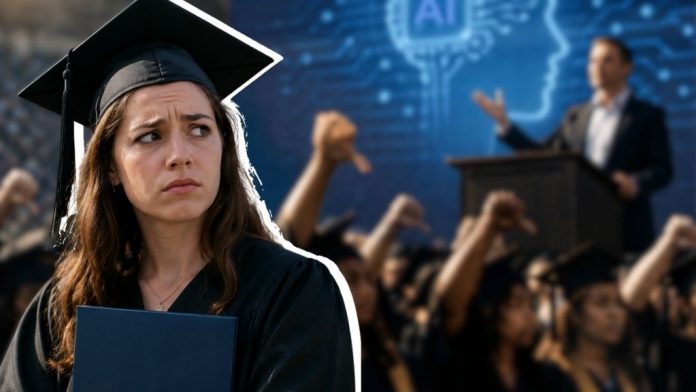
A notable trend has recently emerged in which college graduates are booing speakers who advocate for artificial intelligence (AI) at this spring’s commencement ceremonies.
At schools like the University of Arizona, University of Central Florida, Marquette University, and Middle Tennessee State University, students openly pushed back against commencement speeches that praised AI and its role in the future workforce.
This trend highlights the growing disconnect between graduates entering the workforce and employers rapidly integrating AI into daily operations. For small business owners, overlooking that tension could create new hiring challenges.
Career stability
Much of the backlash stems from uncertainty surrounding employment and automation. A 2025 poll from the Harvard Kennedy School found that 70% of college students view AI as a threat to their future job prospects. Additionally, Gallup data revealed that Gen Z’s concerns about AI continue to rise, even as many young adults regularly use the technology.
Similarly, unemployment among college graduates ages 22 to 27 has climbed to its highest level in 12 years, intensifying concerns about career stability and entry-level opportunities.
However, graduates are pointing to conflicting messaging from universities. While many institutions discourage or penalize AI use in coursework, they simultaneously are inviting speakers who encourage students to embrace AI-driven workplaces.
A graduate from Marquette University shared that she applied for around 30 jobs but did not receive any offers, even though many listings required applicants to “collaborate with AI,” a skill that her classes never formally taught her.
What this means for small businesses
For small and midsize businesses, the disconnect may create an opportunity to differentiate themselves from larger employers.
SMBs that clearly explain their use of AI, incorporate AI literacy into onboarding, and define entry-level roles emphasizing human judgment and decision-making can stand out in a labor market filled with vague expectations.
The backlash does not necessarily reflect opposition to AI itself. Rather, many graduates appear frustrated by the uncertainty surrounding how the technology will reshape hiring, training, and long-term career growth.
Small businesses that provide structured training, transparent workflows, and clear expectations from the very beginning may be better positioned to attract young talent at a time when larger employers risk alienating them.
 ASBN, from startup to success, we are your go-to resource for small business news, expert advice, information, and event coverage.