
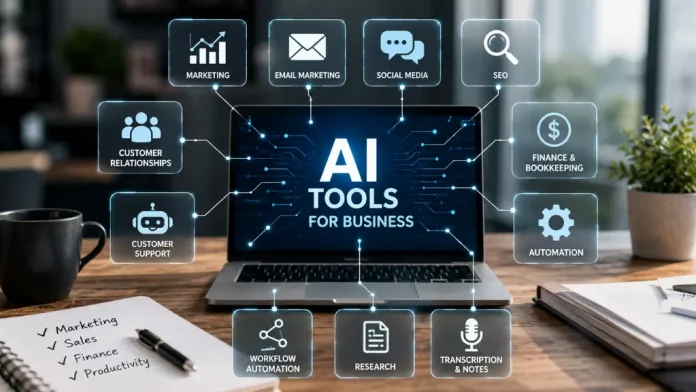
Small business owners aren’t testing AI on the side anymore, they’re building it into daily operations. 82% of small business employers have already invested in AI tools, according to the Small Business & Entrepreneurship Council’s 2026 Small Business Tech Use Survey. The typical small business now runs about five AI tools across different functions, from marketing to bookkeeping to customer service.
For owners who haven’t started, or who want to add capability without adding cost, here are 10 of the most useful AI tools and AI-powered software applications for small businesses right now. Every one on this list is free to start, or offers a free trial for qualified users.
Marketing & content
Marketing is the number one use case for AI among small businesses, according to the SBE Council. From automating email to social media and more, businesses are finding ways to put AI to use in their marketing departments.
Canva: You may be familiar with Canva as an online image-editing tool, but it also offers powerful AI features. Magic Write generates on-brand copy, Magic Design builds templates from a prompt, and background removal works in one click. For a small business without a design budget, it replaces work that used to require a freelancer or an agency.
Cost: Free plan available. Pro starts around $13 to $15 a month.
Link: canva.com
Mailchimp: The popular email marketing platform now has a built-in AI layer, Intuit Assist, that handles subject line generation and send-time optimization. Email remains one of the highest-return digital channels available to small businesses, and the AI layer is designed to capture more of that return without added staff time.
Cost: Free plan available with basic AI-assisted marketing features. Paid plans unlock more advanced AI capabilities, starting around $13 per month.
Link: mailchimp.com
Buffer: This social media scheduling tool includes an AI Assistant add-on. Its standout feature is caption repurposing. Simply paste a blog post link, and Buffer generates platform-specific captions for Instagram, LinkedIn, X, and Facebook simultaneously.
Cost: Free plan available. Paid plans start at $6 per connected social channel per month, and AI Assistant is included.
Link: buffer.com
Surfer SEO: An AI-powered SEO tool built around a content editor that scores writing in real time against the top-ranking pages for a target keyword. Instead of guessing what to cover, owners get a clear structural target for their content.
Cost: Free trial. Paid plans start around $89 a month.
Link: surferseo.com
Sales & customer relationships
Sales and customer relations are where AI touches revenue most directly. New AI tools are helping business owners manage leads, close deals, and keep customers happy without adding headcount.
HubSpot: Best known as a CRM, HubSpot has built AI directly into its core platform for tasks like lead scoring, follow-up suggestions, and pipeline management. For a small business without a dedicated sales team, it can flag warm leads automatically and suggest when to follow up.
Cost: Core CRM tier is genuinely free. Paid plans add more advanced marketing and sales features.
Link: hubspot.com
Tidio: An AI-powered live chat and chatbot tool built for small business websites. It handles a large share of routine customer questions automatically, freeing up the owner or staff to focus on the complex issues that actually need a human.
Cost: Free tier available. Paid plans start around $29 a month.
Link: tidio.com
Operations & finance
Not every use of AI is customer-facing. Some of the biggest time savings for small business owners come from the unglamorous work behind the scenes, moving data between apps and keeping the books straight.
Zapier: This tool connects thousands of apps and uses AI to build workflows from plain-English descriptions. Instead of manually moving data between a website form, an email tool, and a spreadsheet, an owner can describe the workflow once and let Zapier handle it.
Cost: Free tier covers about 100 tasks a month. Paid plans start around $19.99 a month.
Link: zapier.com
Zoho Books: A full accounting platform with its AI assistant, Zia, included at no extra cost. It handles invoicing, bank reconciliation, and basic financial reports, giving owners a real-time view of the business.
Cost: Free plan available to eligible solopreneurs and microbusinesses. Paid plans start at $20/month, or $15/month when billed annually.
Link: zoho.com/books
Research & productivity
Businesses run on information and time, like knowing what’s happening in the market and making sure nothing said in a meeting gets lost. These tools handle both, cutting hours of manual research and note-taking down to minutes.
Perplexity: An AI-powered search engine that provides sourced, cited answers rather than a list of links to click through. It’s built for research: finding competitor pricing, industry trends, regulatory updates, or supplier comparisons in a fraction of the time it would take to search manually.
Cost: Free tier covers most small business use cases. Pro starts around $20 a month.
Link: perplexity.ai
Otter.ai: An AI meeting assistant that automatically transcribes and summarizes conversations in real time. For a solo owner or a small team without a dedicated notetaker, it turns a client call or team meeting into a searchable record without anyone having to type a word.
Cost: Free tier available. Paid plans start around $8.33 a month.
Link: otter.ai
Start small and stay ahead
Adopting AI doesn’t have to mean a big budget or a steep learning curve. Every tool on this list is free to start, and most pay for themselves in saved time within the first few weeks.
The businesses pulling ahead right now aren’t necessarily spending the most on AI. They’re the ones who started early and built it into how they actually work. Many experts suggest picking one tool that solves your biggest time drain, getting comfortable with it, and adding the next when you’re ready.
 ASBN, from startup to success, we are your go-to resource for small business news, expert advice, information, and event coverage.