

The gap between visibility and revenue is becoming one of the most urgent challenges facing today’s experts and entrepreneurs. Across stages, podcasts, conferences, and digital platforms, professionals are gaining exposure at unprecedented levels, yet many still struggle to translate that attention into sustainable income and structured business growth.
Inspiration is not the issue. Execution and infrastructure are.
This disconnect is especially evident in the traditional speaking and conference ecosystem, which has long prioritized content delivery over business development. Experts are often positioned as the primary source of value at events, yet leave without the systems, frameworks, or economic tools needed to turn their expertise into scalable enterprises.
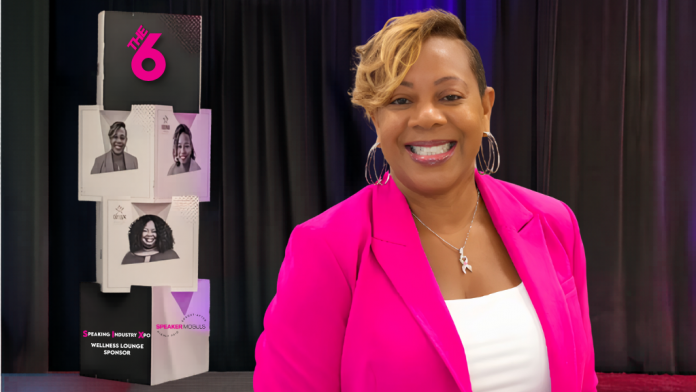
Kelly Charles-Collins, Esq., known as The Speaker Mogul, is addressing that gap directly with a model that reframes speaking as a structured business system rather than a performance-based opportunity. Through her AI-wired incubator experience, THE 6 Speaking Industry Xpo, she is pushing back on long-standing industry norms around compensation, positioning, and the role of the speaker in value creation.
In a wide-ranging Q&A, Charles-Collins breaks down what she believes is fundamentally broken in the speaking industry, why visibility alone fails to generate revenue, and how experts can rebuild their businesses around CEO-level thinking, AI infrastructure, and pricing models tied to real economic value.
The speaking industry model
Charles-Collins argues the core flaw in traditional conferences is not content quality, but a lack of execution support. Attendees often leave inspired but without any systems to apply what they’ve actually learned.
She also critiques what she calls a broken industry structure, in which speakers drive the value of conferences yet are frequently underpaid or unpaid, even as attendees pay dues, fees, and certification costs.
From her perspective, that imbalance persists because speakers continue to participate without challenging the underlying business model.
A central theme in her approach is the shift from “talent mindset” to “CEO mindset.” She argues that many experts remain stuck in the identity of a performer even after transitioning into entrepreneurship.
“In corporate, you were hired as talent,” she explains, “as a business owner, you are the founder of a business enterprise that hires you as the talent to go deliver.”
According to Charles-Collins, this shift is essential for breaking the cycle of underpricing, free speaking engagements, and inconsistent revenue.
Visibility without positioning creates stalled growth
One of the most common mistakes she sees among experts is equating visibility with business success.
“Visibility without positioning is just noise.”
She asserts that many professionals gain exposure through stages, podcasts, and social media but fail to convert attention into revenue because they lack clear positioning, offer structure, and pricing strategy. Without those foundations, she argues, experts remain “visible as performers and invisible as business owners.”
AI-wired infrastructure as a business operating system
Additionally, Charles-Collins emphasizes the role of artificial intelligence (AI) in scaling expert businesses. She defines “AI-wired” systems as infrastructure that automates and systematizes repeatable business functions, not just content generation.
Her own ecosystem includes what she calls the Mogul Operating System, a suite of AI advisors designed to handle positioning, messaging, pricing, sales, and revenue planning.
She also integrates AI into dashboards, workflows, and client systems, describing it as a way to build “a business that operates like a team, even when it is just you.”
Charles-Collins is direct about the financial consequences of underpricing. She alludes to data showing low average revenues among Black women-owned businesses and high failure rates within five years.
She argues that underpricing leads to a chain reaction: unstable income, inability to reinvest, lack of retirement savings, and stalled wealth-building.
Beyond finances, she also highlights the psychological toll, including self-doubt and a return to corporate environments that many founders previously left due to bias or burnout.
Building scalable, high-ticket expert businesses
To move from service-based income to scalable models, Charles-Collins emphasizes three shifts:
- Profit-centered thinking
- Value-based pricing
- Dual-engine business operations
She stresses that experts must stop exchanging time for money and instead price based on transformation and outcomes.
“Clients don’t buy your process,” she said. “They buy the result of your process.”
She also warns against the three pricing traps: anchoring to former salaries, comparing to peers, and discounting out of guilt.
THE 6 delivers measurable business outcomes in 90 days
At THE 6 Speaking Industry Xpo, attendees worked directly inside AI-wired frameworks to produce tangible outputs, including positioning statements, offer structures, pricing benchmarks, and 90-day revenue roadmaps.
Charles-Collins says the goal is not inspiration but measurable implementation.
Within 90 days, she expects participants to see clearer positioning, stronger lead pipelines, and increased revenue aligned with their value.
After attending the Xpo, attendees described gaining clarity on pricing, refining offers, building AI systems for prospecting, and shifting their identity from employee to business owner. Others emphasized the value of structured networking through her Collabosourcing® methodology, which replaced informal networking with guided relationship-building sessions.
Several participants reported immediate business changes, including updated branding, revised pricing, new client acquisition, and development of signature talks.
Ultimately, Charles-Collins positions THE 6 and Octagon Haus, a private economic network for accomplished women experts, as part of a larger ecosystem designed to expand visibility, generate revenue through strategic collaboration, and build the infrastructure to scale sustainable businesses, rooted in intellectual capital.
“The goal isn’t worth,” she said. “The goal is value. And until experts understand their value clearly enough to price from it, the industry stays exploitative and the businesses stay unsustainable.”
 ASBN, from startup to success, we are your go-to resource for small business news, expert advice, information, and event coverage.